Saturday, July 30, 2011

L&T Finance IPO: Why did I not invest?

L&T Finance IPO talks picked up steam lately. Everyone appear to be interested in the gold company primarily for its brand value. But should brand value be the only criterion while making an investment decision in such a jittery market? 

L&T Finance is a holding company. Their corporate structure as given in the offer document is thus.
I generally prefer not to venture into holding companies for it is N times difficult to assess what is going on in reality than a single company. Chances of false reporting (after aSatyam saga we all should give such things a serious thought) are very high in case of holding companies. 


Secondly, they are planning to use a portion of thus generated capital to pay off their debt. To me this is not a very good use of capital. In the offer document they have declared the proceeds will be used to pay off parent company's debt in the ratio as displayed in the left image. The debt is eating away only 9% and if L&T Finance is using the share capital to pay off debt, it is almost sure that they don't have a very good hope on profit generation.

Thirdly, as per my raw calculations, this IPO is little over-priced and retail investors may not get even the listing day gains. The Diluted EPS for 2011 was Rs. 2.83, and for 2010 it was Rs. 2.17. It was a negative of Rs. 0.05 in 2009. At the EPS of Rs. 2.83, and the higher range of Rs. 60, the P/E multiple comes out to be about 21.2, which I think is not too rich, but not cheap either. Especially so because their own prospectus lists down their competitors and their respective P/E ratios on the closing price of July 1 2011, and basic EPS of 2011. On the similar notes its P/B ratio too is not very encouraging to me at the given price band.

However, in the group of NBFCs, L&T Finance is still a better bet for longer term investment horizon. Currently my focus is little too short term, thus I have decided to vary of subscribing for this IPO for the time being. I will keep an eye on it on the listing day and buy up then on discount.

Tuesday, November 16, 2010

Investment buckets

I have been discussing my investment objectives in my various posts. Here in this post I am going to jot down a high level plan to meet my investment goals.

I have divided my total savings into four chunks majorly.

1> Bond Fund Chunk: This contains 30% of my total investment. I keep this fund in safe heaven such as AAA rating FDs, NSCs and PPF (yes I consider PPF a very good investment vehicle). In this bit of my investment planning, I am allocating money for my short term needs such as my education etc. I am happy with 8%-9% growth in this investment chunk.

2> Opportunity Fund: This is the most liquid part of my income portfolio and never exceeds 10% cap. I keep it in my savings account and use it to take advantage of news based sentiments. ICICI buying BOR, petrol prices etc. Since I am not a regular follower of complex news items, this part of the portfolio remains cash most of the time.

3> Medium to Long term Equity fund: This contains 30% of my investment capacity. I allocate this capital for various equity linked avenues. A part in Mutual Funds and a part in stocks. Here I choose companies which have good management and have wonderful business concept/moat and are to grow for sure. I consider Moser Baer, ABCIL in such category.

4> Dividend chunk fund: This consists my rest 30% investment chunk. Here in this part of the portfolio I would rather invest in a company that gives good dividends. My aim from this pocket of investment is to have capital appreciation and maintain a regular flow of income in terms of dividends.

Having said all this, I shall deliberate more on what to vehicle to choose for each investment chunk in further posts.

Monday, November 1, 2010

The Intelligent Investor: The Bible

Had reread the bible the first day of Diwali vacation. Cannot agree more with 'the Graham'; the basic principles he laid 50-60 years ago are so true even today.

I have extracted following main points from the book.
  1. Beware of companies which are always interested in other people's money. They can be easily noticed by their acts of continuously diluting equity, issuing warrants, issuing convertible debentures (convertible bonds are double edged sword, Graham says. Companies management it betting on the fact that stock prices will always go up and people will eventually convert their bonds to stocks. This expectation gives them incentive to do financial alchemy to ensure that stock prices some how carry on going up. But we all know this is not sustainable).
  2. Beware of companies' which have taken more loan than the cash they can generate. Take example of Rei Agro. They pay close to 340 crore as interest payment on the debt and generate net profit 150 crore. Are they sustainable? I don't think so.
  3. Always look into the net profit and operating cash flow. Net profit should never be more than the operating cash flow. If a company continuously show such relation, beware!
  4. A combination of high entry cost and good margin makes the company out smart the competition easily. TTK Prestige is an example from my kitty. No road side company can breach the brand Prestige easily.


Wednesday, October 20, 2010

Coal India: IPO analysis

Coal India has come up with the biggest ever IPO in the Indian Stock market history. Government, however, is being greedy these days and further offers of PowerGrid, Shipping Corp. of India, ONGC, IOC are coming. It is interesting to understand where is the money in the market for these issues. Anyway coming back to Coal India.

Summary:
As per research by CRISIL, CIL is world largest coal producer and largest reserve holder. India is world's third largest coal producer and consumer. CIL met close to 82% of coal demand in India; In India power generated from coal was 52% of total power (FY2009). Apart from power generation, coal is heavily used in cement and steel plants.


Negatives:
  1. Coal India is a holding company and its results and profitability is dependent upon  its subsidiaries.
  2. GOI is selling its stock. Gains from this offer will not be part of Coal India company.
  3. The current state of transportation available will not help even if Coal India could increase its production. 
  4. Coal India may (and probably will) face problems in land acquisitions. It also has mandate to share 26% of its profits with the affected people.
  5. India is a power hungry country; still many NGOs have been working relentlessly against such power plants, and their efforts may result in Coal India's loss.Greenpeace is already on to this link.
  6. Estimation of coal reserves is pretty much subjective process and could be incorrect.
  7. Coal India sells its coal below international price (although coal has been deregulated since 2000)
  8. Much of its assets are located in politically unstable areas.
  9. Finding further coal fields has risks of not finding, not enough coal finding, and not finding a good grade coal.
  10. Illegal mining.

Positives:
  1. Largest coal producer and largest reserve holder. Apart from this, there is enough unmet demand in India.
  2. Strong and stable financial track record.
  3. Has started ERP implementation. For company of such a scale, ERP implementation will pay dividends in long term.
  4. Focused on increasing resources by venturing into outside India.


Sunday, October 3, 2010

Castrol India: A little analysis on dividend

To start with I have calculated Castrol India's dividend yield from last 10 years dividend data on the basis of current stock price. Now I will try to fit a regression line (using TREND function from MS Excel) and find out from which year I will start beating the risk free return of 7.5% of FDs.
My aim from this analysis is to understand if Castrol India will be a good investment choice for my dividend portfolio at current price.


So what is my conclusion?
I will wait for Castrol India a bit. I think I should achieve my dividend target of > 7.5% way before 2020.

Five good equity diversified funds for analysis

All the numbers have been picked up from valueresearchonline.com


So what is my conclusion today?
ICICI Prudential has historically performed better than the other three 5 star funds.
SBI Magnm contra was a good fund, but it is sliding down slightly
Reliance growth is a good fund but has high volatility

How to choose a good mutual fund

One line answer: select any 5 star or 4 star fund from www.valueresearchonline.com.

Long answer: look at the track record of various mutual funds, monitor how have they performed over the period of time and how the performance has been lately. Check out couple of ratios and bingo!

Let's take HDFC Top 200 (this is my personal favourite fund) : (All these screen shots are from valueresearchonline.com)
I have highlighted the important aspects:
  1. It is 5 star fund
  2. Its return grade is high and risk grade is below average
  3. Trailing returns for 1 year is 32%, for 3 years (compounded annually) is 17.30 (due to 2008-09), for 5 years it is 26.67 (stupendous) and from launch it has been 26.71 (fantastically stupendous).
Now if we go to Performance tab the scene is as following:
This image has couple of important points. Fund returns with respect to category return, with respect to Nifty and with respect to Sensex.
There are other ratios:
  1. R-Squared ratio: is the statistical measure of how well an approximation (regression) line matches with the real data points. It is an analysis of the deviation from the benchmark. For equity funds, the benchmark is Nifty or Sensex. This ratio varies from 0 to 1. 0 says there is no correlation while 1 says there is 100% correlation. This mutual fund's R Squared is .96, which means it is closely tied to the fluctuations/returns in the Sensex.
  2. Alpha ratio: tells how better a security has been against the bench mark. Alpha of 9.41 says that this mutual fund has been outperforming the benchmark Sensex by 9.41%.
  3. Beta ratio: talks about the volatility of a security as compared to the benchmark. If the beta value is more than 1, the NAV of that fund will fluctuate more than the benchmark. If the beta is 1, it will go along with Sensex. If the beta value is less than 1, it means the security is not much volatile and safe. This fund comes into this category.
  4. Standard deviation: is another measure of volatility in the fund. It is calculated on the historical annual rate of return data. It is a measure of how the funds performance deviates from the average performance over a period. A low standard deviation is better. This fund apparantly has it little higher side, but this is due the recession (and jump back after that) effect.
  5. Sharpe ratio: is one of the most important ratios for risk analysis of a fund. This ratio also throws light on the fact that the fund's performance was just a fluke or due to a smart fund manager. Sharpe ratio gives a sense of returns from a fund over the risk less return per unit of risk. Risk here is the standard deviation. The higher Sharpe ratio, the better it is. But it all alone doesn't guarantee any information. It is calculated as ((expected return - risk free return)/standard deviation). If the standard deviation is very low (for liquid funds) the Sharpe ratio could come very high but that doesn't guarantee higher returns.
Other tabs are self explanatory and can be easily understood.
In the next post I shall provide a list of 2010's good equity mutual funds and their ratio analysis.

So what is my conclusion here?
Always look at the risk side of your investments. Don't distribute your hard earned money to agents.

Disclaimer: I am not advocating anyone to buy HDFC Top 200. This is my personal faviourite mutual fund. I have selected it based on my risk profile and objectives from investing.

Saturday, October 2, 2010

Understanding a company's financial strength

A company generates following reports annually.
  1. Balance sheet (on 31st March)
  2. Income statement
  3. Statement of cash flow
These three documents are the only tool with common investor to assess the company's financial strengths. (I am certainly not discounting insiders :-)

Lets understand these concepts via mind maps:
Balance Sheet
Income Statement
Statement of Cash Flow
Statement of cash flow is the most important document. If the company is unable to keep positive cash from operations, still it is able to show net earnings, it could be a sign of window dressing.

Highest NAV plans!!! A guarantee or another financial alchemy?

First thing first, does highest NAV mean highest ROI? Nope, they say that it is the highest of whatever they can manage to attain. It is very unlikely that with such a guarantee in place, they can provide even bench mark returns.

Let’s have a close look at how a possible highest NAV plan will work. They use Dynamic Hedging and Constant Proportion Portfolio Insurance. Although I don't fully understand these concepts, we actually don't need to digest this financial alchemy. Let's try to figure out how a common man would manage such plans.


Rule1#: If you have to provide some guarantee, you will have to charge some money for that. That money has to be taken from the fund value.
Rule2#: Stock market can never be guaranteed anything. It may crash anyway. So fund managers will have a pressure to minimize their risk and keep money in debt instruments and fixed deposits.
Rule3#: Since the lock in period is pretty big, 7-10 years, some amount of market risk can be adjusted here and there.

Let’s assume that the average interest on a secure debt instrument will be 7%. For the sake of simplicity I am assuming that the fund administration charges and other charges are 0.

Suppose the current NAV (and total fund value) is Rs 100. The fund manager wisely allocates the money in stock market, and after 1 year it gives 20% returns. The total NAV is Rs 120. Now the fund manager has the obligation to pay at least Rs 120 after 9 years. Now fund manager cannot take the risk of putting everything in stock market as it doesn't come with the guarantee. The debt product gives the guarantee. So the fund manager will have to pass a portion of total fund value to debt product to assure Rs. 120.

X*(1.07) ^9 = 120 gives X as ~ 65.

So the fund manager will allocate Rs 65 to some debt product and 120-65 to equity market again.

Let’s say after another year, the market resulted in good returns, and Rs 55 invested in the market sees another 20% jump. Now the total fund value becomes 65*1.07 + 55*1.2 ~ 146. Now the fund manager has the obligation to pay at least 146 Rs after 8 years. To provide this fund manager will need to solve this equation.

65*(1.07) ^9 + Y*(1.07)^8 = 146

This gives Y ~ 11.

Now fund manager will allocate additional Rs 11 to debt market, and put rest 44 in the equity market.

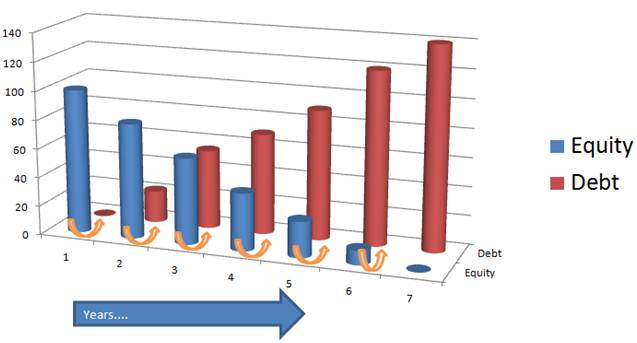
Let’s assume this process continues and after 6th year you have assured sum as Rs 180. By that time the equity component will be almost negligible and even if the market is highly volatile, it will not affect the fund value.

So absolute returns after 7 years will be 80%. (This is another gimmick, they will immediately say, sir which bank assures 80% returns and YES THEY DO SAY SO). If we calculate the effective rate of annual return it will come around ~8.7%. Which is marginally better than an FD (if we include the tax saving, it may be a bit better) but do we really want ~9% from the equity market for next 7 years period? Even the balanced mutual fund will give much more than 12% for this time frame. The few best MFs in my view have given more than 25% over the period of 15 years.

Pictorial representation of what I wrote will be like this.

So what is my conclusion today?

Whenever someone is guaranteeing something, please ask...what is the cost of guarantee? Are you into charity? :-)

Friday, October 1, 2010

ULIP and MF: A comparison from my portfolio

I think I was lucky that I chose a good ULIP (an oxymoron? ) SBI ULIPII. Around the same time I invested in a Tax Saving MF SBI Magnum Tax gain (G). After 4 years, lets see what is the actual absolute profit in both the investments.

I started my ULIP in April 2007 for 30000 annual premium (paid annually). I lie into the tax slab of 30%; rebate is given to me (for whole 30000) monthly at the very start of the financial year. I will use discount rate of 9% (assumed average inflation rate) to discount the time value of money back and forth.

Now I will do the similar calculation for my SIP in SBI Magnux Tax gain.

The difference is clear between the two. It doesn't look a lot since my choice of fund was not good. Had I chosen the HDFC tax saver, the current profit for the ELSS MF would have been much more than Rs 1,25,000

So what is my conclusion today:
Avoid ULIPS as much as you can and invest wisely in an MF which has a good track record.

How to know if you are being trapped into mis-selling

I think the various agents have mastered the art, the science and what not of miss-selling. Still a few key sentences can be observed and you should be alarmed of the miss-selling.
  1. Sir, see this policy has give 100% returns. If you dig down, he will explore the papers and show you the absolute 100% returns since 2005. Well 100% return in 5 years doesn't make it much more than 15% returns (compounded annually). Although 15% annual is a good return, but it is not that 100%, of which you are being lured.
  2. Sir, see this wonderful policy is the money maker! It has returned 60% in one year. Well if you look little deep, he has data from sensex at 8000 to sensex at 18000. Any mutual fund has given much more than 80% during this period.
  3. Sir, there is a guaranteed bonus of 180%. Here you have to really understand and read between the line. Your agent will stop at 180% nonsense. If you are smart you will ask, 180% of what? total sum? Then the agent will sheepishly say, no sir of the annual premium. You then have to ask, ok when? As I buy the policy? The agent sweats a bit and says, no sir after 15 years. Suppose you take a policy of 10000 annual premium, you are being lured for 10000 additional bonus after 15 year. With the average 10% inflation, the NPV of that 10000 in today's term will be ~2400. So is it worth?
  4. Sir, this is the wonderful time to invest in this mutual fund. Its NAV is only Rs 10. Why to invest in Rs 400 NAV mutual fund. Here you will get a big number of units. Well any sane person after a minute of inspection will understand the folly of the statement. Present NAV doesn't matter at all and secondly one should always wait to see the performance of the fund. Why be the guinea pig?
  5. Sir, you wont believe us! This is the highest NAV plan. You know the market position currently, it is so low, market has to increase 10 times (as if he really plays the market). Just imaging, if you invest 10 Lakhs today, we are guarantying you 1 crore after 10 years. Well can you give it in the writing? No sir, but you see it is highest NAV plan, so there is guarantee anyway. It is guaranteed by IRDA as well. But the foolish agent doesn't tell me the guarantee of NAV going up!!! What if NAV increases well for first 3-5 years and then stops (actually thats how all highest NAV plans will work). Is there any respite?
  6. Sir, this is unique ULIP plan and the most important point is that you can withdraw your money after 3 years. Someone bitten once like me can understand that the deductions in the ULIPS (old) are highest for the first 3 years. What indirectly he is suggesting is to pay him commission from your pocket and forget it.
Jai ho! The art and science of miss-selling is still being taught at the premier institutes of wealth creation.

Wednesday, September 22, 2010

My ULIP agent: Many many thanks to you

Flash back to January 2007. I had joined a new company, got good package and had a good sum returned from previous company. By the end of Jan it was raining tax savings schemes and alike instruments all around. I was asked to provide my tax saving stuff and alas I had nothing. Suddenly one fine day the God himself decided to meet me in the form of an ULIP agent. He offered me a product too lucrative to be ignored. I thought one should listen when opportunity knows. I wholeheartedly poured in 70K as the annual premium for the sum assured 7 lakhs. The God said, you look so healthy, nothing will happen to you, thus 7 lakh is more then sufficient for the insurance cover. I happily agreed, after all he was personal finance God.

Fast forward to Jan 2008; The stock market was euphoric and the wisest man inside me chose the "Growth" option in the ULIP, I was too happy to blab about my investment mantra and intelligent decisions. To boast about it I logged into the my savior ULIP web page and hit the 'fund value'. The whole world rolled in front of my eyes. While even my 'kam wali bai' had earned a lot in the stock market during that period, my safe fund showed me my fund value a little more than 30K. I thought to bash at the agent, who conveniently cut the phone. I then rang to the respective insurance company, who enlightened me with the fine details I didn't bother to read previously.

My policy had a funny deduction structure.
  1. From the first premium 65% will be deducted as administration charges plus agent commission.(Oh God!)
  2. Mortality charges
  3. Some other management charges1%
  4. 10% service tax and 2% education tax (close to 10.2%)
  5. Some 2.75% annual charges
I was amazed at the scene of such a wonderful looting scheme and thought to cancel it. I then was enlightened about the surrender charges and I realized that I would have to pay more to surrender it :-) 

This was the mistake part of my investment life. I thanked my investment agent to teach me a wonderful lesson. I realized the importance of reading the fine print and more importantly, understanding the personal finance. That event left me a much more learned and motivated person.

Many many thanks Mr Agent!!!

P.S I still pat my back for not felling for this. The first year charges are 100%.

Monday, September 20, 2010

Stock selection methodology

Having served the role of project manager for a few projects, I like to present everything as a WBS. So here is my long promised my WBS for stock selection. It still needs a PERT chart analysis. Stay tuned...

Friday, September 17, 2010

A few dividend stocks I am looking into

I am looking into these three dividend paying stocks. The current filter criterion is dividend and nothing else. If this screen test passes I shall look into other matrices.
The graphic above tells the dividend paid as percent. This can help us analyze the dividend trend, stability and deviation (I use standard deviation to measure deviation).

I make a dividend portfolio which will give me a stable income after a few years, I am much interested in stable (if not increasing trend). I will put "Andhra Sugar" off based on this criterion. Having left with Castrol & Valson, it is imperative to understand yield part of the dividend. I will use today's prices to calculate the dividend yield. This will help me understand the trend.
Valson has been giving consistent dividends of more than 8%, it is much more than any A grade bond and FD provides today. At this stage I will place this stock in my to further screening criterion.
A closer look as Castrol dividend yield chart reveals that is has picked up an increasing trend. The financial health of the company is good and the brand image is good. I have multiple reasons to believe that it will yield 8+ % in coming 5 years. This should go to my dividend portfolio for sure.

Wednesday, September 15, 2010

My equity portfolio allocation

This is the state of my current portfolio. In spite of heavy rebalancing it is still tilted towards oil & gas sector. Any government policy change can decide the direction of my portfolio.

This metric is based on the current capital allocation. The another metric I follow for rebalancing is dividend income. I dont want my dividend income to be tilted on any side otherwise the stability factor goes away.

My current asset allocation

Since quite some time I have been working a lot on my asset allocation. Asset allocation is one way of reducing the risk possibility.

I strongly believe that bonds and debts should be much more than 30% in once portfolio for that provides a solid foundation.

Bharti Airtel : Express your self

I am a great fan of good management. In fact this is my one of the stock screening criterion. Two days back I was reading an article in hindubusinessline.com. The article was about another great personality I admire. I admire him because he talks of future.

....There are 600 million phone users in India whereas the country has only 55 million bank account holders. The way towards financial inclusion — getting the unbanked into the net — is through the mobile money route, feels Sam Pitroda, tech evangelist and currently advisor to the Prime Minister on public information infrastructure and innovations.

In his new book, The March of Mobile Money, co-authored with Mehul Desai, CEO of C-Sam Inc, a company that Pitroda founded, the two discuss the disruptive nature of mobile money technology....

Just after reading this article, there was a flash in my mind. What if the competition mired mobile companies enter into mobile money. Then I thought, who else but great Sunil Mittal can take such a step. Wish I could have asked for something else as what I wished came true. Bharti Airtel has got the license for mobile payment. Is he fond of creating bule oceans?

I am happy about my continued long position on Bharti Airtel. I have been acquiring it since 280 levels. I am very long on good managements.

Monday, September 13, 2010

Dividend Investing

I am a big fan of dividend based investing. I have learned and incorporated this methodology of investing after burning my hands in 2008 crash ;-) and reading tipblog. I simply adore this guy.

Anyway coming to the point of investing. I have become great follower of dividend based investing for these few reasons.

  1. Dividends provide a steady stream of income: Dividends work as additional source of income on which you can count on (provided your stock selection was good). It is largely different from the movement of the stock prices in the market. During FY09-10 my dividend income was Rs 11,004 (tax free). Secondly a consistent stream of income is always better than money once at a time.
  2. Dividend stocks prices mostly go up: In my investment experience I have seen that dividend paying companies are always relied upon by many investors and gradually the stock prices go up. In fact I used dividend yield as one screening criterion for stock selection. My recent dividend investment was Tata Steel. I started acquiring it from 475 levels up to 500. My average dividend yield is close to 4%. Since then I have seen a steady rise in the stock price. Currently it has crossed 600 level.
  3. Dividends increase: Generally big and mature companies become dividend paying companies. We may not see meteoric capital appreciation in such stocks (and truly speaking dividend investing is not much about capital appreciation). Smaller companies need more capital to grow thus cannot afford to pay dividends (and taxes). Big organizations earn lots of profit, thus can afford to share in spite of having growth plans. I generally like companies having 20%-30% dividend payout factor. In my stock selection I have seen that dividends have increased (in rupee value) consistently. I firmly believe that 4% dividend yield will become at least 8% in next 5-8 years. And if India has to grow, interest rates will have to come down in near future. Which security will give me 8% (and increasing) rate of returns after 10 years?
  4. Dividends have benefit of SIP: Why SIP is good? It is good because if promotes rupee cost averaging. What to do with dividends? In my view dividends should be reinvested as the stock price comes down. This will help increase the portfolio value and with the effect of compounded interest, my retirement will be peaceful.
My recent dividend stock picks: Tata Steel, Titan Industries, IDBI bank

How much insurance cover do I need

If we ask a typical agent, they come up with the magical figure of 10 times of annual income. I was also advised this almost an year ago. The logic they probably have is that a person with X income would easily be able to pay "X/some number" amount of premium easily. At least I don't subscribe to this logic.

~~~~~~~~~~~~~~~~~~~~~~~~~~~~~~~~~~~~~~~~~
Consider Mr X: A typical Indian family man
He is married
30 years
Has a home loan for which monthly installment is 35k
Has a car for which installment is 10k a month
Has dependent parents, non working wife and a one year old girl child
Earns 10 L PA (take home after taxes)
~~~~~~~~~~~~~~~~~~~~~~~~~~~~~~~~~~~~~~~~~

As per our bright insurance adviser, he should take cover of worth 1 crore.

Suppose Mr X is dead now and his family gets 1 crore. As per current standard of living the monthly expenses would come around 10-15k. Lets take 10k for simplicity of calculation.
Total amount needed monthly 35 + 10 + 10 = 55k
Lets assume that Mr X's family will keep 1 crore in some FDs (considering the 0 risk tolerance) which will safely beat inflation (a big assumption). With 55k as monthly expense, 1 crore would barely last for 15 years. ( I have assumed that car loan will always continue, it will not make much difference int the final conclusion)

This amount doesn't include cost of sudden medical emergencies (which are very likely due to old parents and young child). It doesn't include the cost of education which is going to be very high as time passe and this amount certainly doesn't include the cost of marriage of his girl child.
If we include these factors, the insurance amount should be increased by at least 50 lakhs.
But no adviser will suggest you because they are not trained to do so.

~~~~~~~~~~~~~~~~~~~~~~~~~~~~~~~~~~~~~~~~~
Now lets take Mr Y, a typical software professional
He is married
30 years
Doesn't have a home loan, his parents have one for him
Has a car for which installment is 10k a month
Has dependent parents
A working wife and a one year old girl child
Earns 10 L PA (take home after taxes)
~~~~~~~~~~~~~~~~~~~~~~~~~~~~~~~~~~~~~~~~~

Suppose Mr Y is dead now and his family gets 1 crore. As per current standard of living the monthly expenses would come around 10-15k. Lets take 10k for simplicity of calculation.
Total amount needed monthly 10 + 10 = 20k
Lets assume that Mr X's family will keep 1 crore in some FDs and Equity mutual funds (considering there is one earning member, thus some risk can be taken) .
Lets assume 50L is invested in FD (and MIP) and rest is invested in Equity MF (assume 15% CAGR very safe assumption) .With 20k as monthly expense (in this case car loan will actually stop much before), invested 1 crore would last for more than 70 years. And if invested properly, it will last for even more.
Mr Y's wife's earning will easily take care of his daughter's future cash flow needs.

With the help of these two examples, we can easily establish that the magic figure 10 doesn't make any sense. Cover amount should be estimated individual's risk profile and current financial condition.

Term plan and unawareness all around

What do we think when we think of life insurance? I guess endowment plans!!!
This is what one of LIC agents told a couple of days back.
~~~~~~~~~~~~~~~~~~~~~~~~~~~~~~~~~~~~~~~~~~~~~~~~~~~~~~~~~~~~~
Manish Sir,
XXX is the best policy.Its features are:
Tax Bft:Deduction u/s80C of Income Tax Act,1961.
Period Covered:For first 20 years(with premium)
After that upto Age of 70 years
(without premium)
Premium: According to Age
Bonus : Rs. 6000 p.a.
Addl. Incentive : Rs. 20,000 after 20 years
Accidental Death : Double the policy amount.
If you take Rs. 1 lakh policy you will get Rs. 2,40,000 after 20 years (if you don\'t die).
If death takes place your legal heirs will get Rs.1,00,000 more then the due amount.
~~~~~~~~~~~~~~~~~~~~~~~~~~~~~~~~~~~~~~~~~~~~~~~~~~~~~~~~~~~~~

I calculated premium for sum assured 100,000 for 20 years tenure for me. It comes around Rs. 5660. So if I "invest" 5660 yearly, I will get a tax benefit and my family will get 100,000 or 240,000 depending upon the situation.

Give me a break! My life if worth 240,000? What would my dependents do with 240,000? After all life insurance is a way to protect my from financial loss in future if I don't survive.

How much protection is needed can be roughly estimated; but for the sake of fun, lets take it 10,00,000. For me the premium comes whooping 55,000 per year. Is it really worth?

I guess the 20,000 bonus and 6000 bonus part can be easily ignored. It is just a marketing gimmick.

If we look at historical performance of any endowment policy, none has given more than 6-7% returns compounded annually. If we take the best case scenario of 7% and pay 5660 per year, what I get in the end is 5660*(1+0.07)^20+5660*(1+0.07)^19....5660*(1+0.07)+ which comes around 2,48,276. This is what I get in the end if I survive; If I lose my life in between my family would be showered with 1-2 lakhs and nothing more. This return doesn't not even beat inflation and the insurance amount doesn't cover anything. It wont last even 6 months for my dependents.

By now I have established that endowment policies are not suitable for me. I understand 2,48,000 will not have any meaning after 20 years; So let me think about a plan that doesn't give me anything if I survive but gives a good protection in my absence. Take any term plan for example. I am taking icici's iprotect for illustration purpose.

Sum assured (50,00,000) (this is what my family gets if I die)
Policy term (30 years) (till I am 60) (makes sense, I am sure I will not have any dependents after 60)
Premium only 5600!!!

We dont need to be a finance guru to understand the difference between 100,000 and 50,00,000. The only problem is that I don't get anything if I survive. I lose 1,50,000 over the period of 30 years in this case.

disclaimer: I am not saying that endowment policy is bad and term plan is good. I am not also marketing ICICI's iprotect plan. My only concern is think before you buy!!!